Skip to content

Key takeaways from our Safe and Sustainable by Design webinar

On Tuesday, together with our partners ARCHE Consulting, we hosted a focused one-hour webinar on Safe and Sustainable by Design (SSbD) in research and innovation projects. The session brought together researchers, consultants, sustainability professionals and project developers to explore how the SSbD framework can be applied in practice, particularly in research or Horizon Europe projects.

Understanding the updated SSbD Framework

A key part of the webinar was exploring the role of the SSbD framework, as developed by the European Commission’s Joint Research Centre (JRC). Updated in December 2025, SSbD is a voluntary framework that guides research and innovation on integrating safety and sustainability in line with EU policy objectives.

Participants were guided through the key elements of the framework, from scoping to evaluation, with the SSbD assessment examined in-depth. This involved talking through the three-step approach to the safety assessment of chemicals and materials, providing a practical introduction to completing a Life Cycle Assessment, and an overview of the included socio-economic assessment.

Supporting better innovation choices

The SSbD Framework supports the integration of safety and sustainability considerations early in the research and innovation process. It serves as a decision-support tool that strengthens research design and strategic direction, and prevents regrettable substitution.

During the session, we explored how the framework enables organisations to:

  1. Screen their existing portfolio by mapping hotspots related to safety and sustainability
  2. Identify, during the research and development phase, the safest and most sustainable options for future development
  3. Screen for potential alternatives to substances of (very high) concern

The session highlighted that by evaluating safety and sustainability considerations at an early stage, innovators can reduce downstream risks and avoid costly redesign or regulatory challenges later in development.

Rewatch our webinar

SSbD is a practical framework that is reshaping how research and innovation projects are approached. The SSbD framework is prominently mentioned in Horizon Europe calls. For scientists preparing proposals, R&D and QSHE managers, and sustainability professionals, understanding and applying SSbD is relevant to current and future needs. It also shows how the European Commission aims to guide innovation in reducing the impact from chemicals on humans and the environment.

If you are interested, but were unable to attend our webinar, you can view the recording here.

We are pleased with the strong attendance and positive feedback, confirming the growing interest in practical guidance on implementing SSbD. As Horizon Europe continues to emphasise SSbD, the framework is likely to remain a key consideration in future research and innovation projects.


 

Our news articles are only available in English.

Subscribe to our newsletter

Would you like articles like this in your mailbox once every quarter? Sign up for our newsletter!

Subscribe to newsletter - News

Related Service & Industry

Compliance & LegislationEcomattersLCA & EPD

Want to know more?

Reach out to our experts.

Other news

Key takeaways from our Safe and Sustainable by Design webinar

Key takeaways from our Safe and Sustainable by Design webinar

On Tuesday, together with our partners ARCHE Consulting, we hosted a focused one-hour webinar on…

Ecomatters supports integration of Long-Duration Energy Storage in the Netherlands

Ecomatters supports integration of Long-Duration Energy Storage in the Netherlands

Today marks the kick-off of RenewaFLEXNL, a three-year research project focused on integrating Long-Duration Energy…

Webinar: Safe and Sustainable by Design (SSbD)

Webinar: Safe and Sustainable by Design (SSbD)

Join Ecomatters and ARCHE Consulting for a 1-hour webinar: “Safe and Sustainable by Design (SSbD)…

Ecomatters: Sharing our insights from 2025

Ecomatters: Sharing our insights from 2025

As we head into 2026, we take this opportunity to look back over what 2025…

Industry-wide LCA studies: insights from our recent webinar

Industry-wide LCA studies: insights from our recent webinar

On 3 December 2025, Ecomatters hosted a webinar on how to develop industry-wide LCA studies…

Celebrating a milestone: Certificate for publishing the 1,000th MRPI-EPD

Celebrating a milestone: Certificate for publishing the 1,000th MRPI-EPD

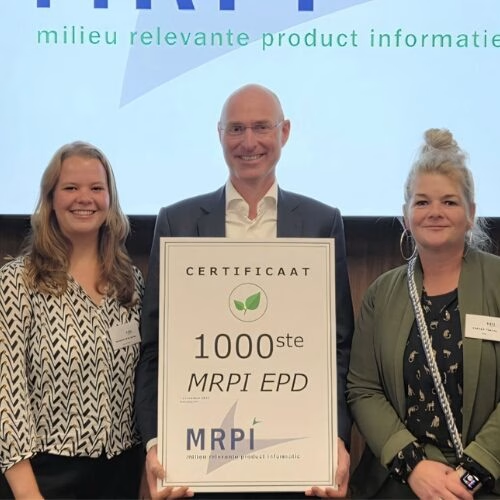
During the MRPI Congress 2025, AkzoNobel received a certificate recognising the publication of the 1,000th…

Add LCA or SSbD expertise to your 2027 Horizon Europe proposal

Add LCA or SSbD expertise to your 2027 Horizon Europe proposal

The European Commission has released the draft work programmes for Horizon Europe 2026 – 2027…

Ecomatters yearly event 2025: A few days in Volendam

Ecomatters yearly event 2025: A few days in Volendam

Every September, the Ecomatters team takes a short break from the daily routine to spend…

Horizon 2026 proposals

LCA and SSbD support by Ecomatters in Horizon Europe 2026 proposals

The European Commission has published the draft Horizon Europe 2026 and 2027 work programmes, where…

LCM Palermo 2025: Explore LCA insights with Ecomatters

LCM Palermo 2025: Explore LCA insights with Ecomatters

Last week, our team at Ecomatters  participated in the 25th Annual Life Cycle Management (LCM)…

Navigating Scope 3 emissions accounting over time

Navigating Scope 3 emissions accounting over time

Accounting for company greenhouse gas (GHG) emissions has become standard practice. Once the baseline is…

Ecomatters’ role in shaping the future of sustainable product design in the EU

Ecomatters’ role in shaping the future of sustainable product design in the EU

Over the past year, Ecomatters has contributed to several preparatory studies for the Ecodesign for…

Back To Top