

How to develop an EPD: Step-by-step guide
EPD process overview
An Environmental Product Declaration (EPD) is a third-party verified document that communicates the environmental performance of a product. It is made in accordance with ISO 14025 Type III standard and often follows additional standards such as EN 15804+A2.
At Ecomatters, we follow a straightforward seven-step process for creating EPDs. In this article we will walk you through the seven steps required to develop your own EPD. These steps are also outlined in the diagram below.
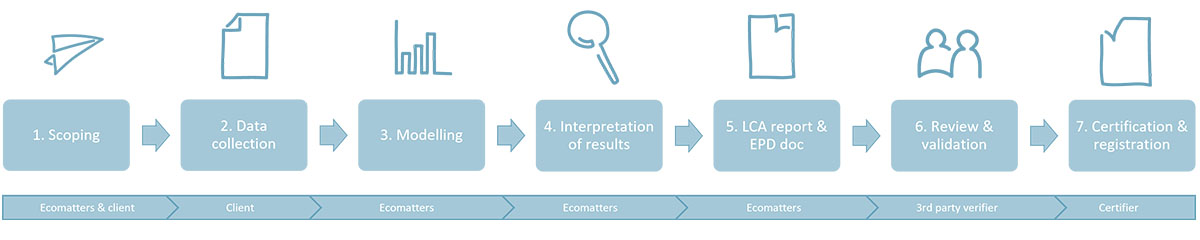
The first step in creating an EPD is to define its scope. In this phase, we discuss the number of products to include, relevant product variations, the life cycle stages to cover, and the standards and certification scheme to use. Once these details are finalised, a budget and timeline can be agreed upon and the EPD process can formally start.
Following confirmation of the agreed scope, data collection can begin. This data collected is used to create the life cycle model (LCA model) and is known as the life cycle inventory (LCI).
A data questionnaire is prepared and completed by the commissioner of the study with the support of Ecomatters. Depending on the goal and scope of the project, data collection may include product manufacturing (raw materials, product characteristics, utilities, waste, etc.), logistics (transport modes and distances), and product use and disposal data. In general, data collection covers primary data inputs and outputs from all the life cycle stages under the control of the company commissioning the study.
Once the data collection questionnaire is delivered back to Ecomatters, we process the data and create the LCA models according to the agreed reference standard (e.g. the EN 15804+A2). During this step we will discuss the LCA model and any assumptions with the client if relevant.
Third-party databases, such as the Ecoinvent database, statistics, assumptions, and other generic data sources, are used to model parts of the system outside the control of the commissioner. This can include the production of raw materials, supply of energy, or end-of-life treatment.
LCA software (e.g. LCA for Experts or SimaPro) is used to construct the model and calculate the results of the study. The input and output flows are translated into actual environmental impacts (i.e. climate change, eutrophication potential, etc.). The results of the study include the product footprint for all selected impact categories, but also the results per life cycle stage, manufacturing process, or activity.
This step also includes the interpretation of the results, leading to the identification of environmental hotspots through the value chain. Conclusions and recommendations are given to substantiate the environmental claim.
An LCA report and EPD documentation compliant with the reference standard is written. The LCA report is a comprehensive document that describes the methodology and presents the study results in detail.
In addition to the LCA report, an EPD document is created. This will be published on the program operator’s website, as well as on the certification body’s website (e.g. ECO platform website). This is also the document that clients can publish through their own communication channels. Compared to the LCA report, the EPD document is more concise and contains less detail.
At Ecomatters, we manage the entire process of EPD creation including being accountable for the verification process. For this, we rely on a broad network of partners for external third-party verification.
Once the LCA report and EPD documents are ready, we send them both to the third-party reviewer. The verifier is responsible for checking and reviewing that the documentation is compliant with the ISO 14025 and the agreed reference standard (e.g. the EN 15804). The verifier will provide us with review feedback, including suggestions for modifications, implementation of additional information in the report, etc.
After implementing the feedback, the verifier will provide us with the review statement needed for EPD certification.
Once the review statement is received, the EPD document is submitted to the program operator for certification and registration in an EPD platform (for example in the ECO platform).
EPD Systems
EPD System Programs
To produce an EPD type III, a program operator is necessary. A program operator can be a company or a group of companies, industrial sector or trade association, public authorities or agencies, or an independent scientific body or other organization. They are responsible for verifying the EPD and managing the platform (e.g. ECO Platform) on which it is published.
The EPD system program operator is an independent agency whose role is to conduct, administer, and supervise the development of a type III EPD. Therefore, it is responsible for the development and/or identification of existing product category rules needed for an EPD. Usually, each country has its own program operator(s) and thus its own EPD system.
Some of the European EPD systems and their country of origin are:
- Institut Bauen und Umwelt e.V. (IBU) Germany
- Inies FDES France
- EPD Danmark Denmark
- EPD Norge Norway
- The International EPD® System Sweden
- BRE United Kingdom.
- Global EPD Spain
- ITB-EPD Poland
- Bau EPD Austria
- DAP construccion Spain
- EPD Italy Italy
- DAPHabitat Portugal
- ZAG EPD Slovenia
- EPD Ireland Ireland
- MRPI The Netherlands
- B-EPD Belgium
- PEP Eco passport
The ECO Platform
The ECO Platform was developed to harmonise the verification of environmental information (EPDs type III) within the construction sector. It is an international non-profit association that acts as an umbrella organisation for European EPD programme operators and aligns their EPD programs.
Most major European programme operators support the ECO Platform. It issues ECO Platform EPDs (ECO EPDs), which are recognised across Europe and can be used not only in the European market but also in international markets.
Ecomatters Support
Ecomatters has extensive experience supporting companies with making EPDs. Through our partner relationships with reviewers and program operators, we help ensure the LCA is correctly verified and published on the appropriate EPD platforms. We have specific expertise with the ECO Platform and the dutch “Nationale Milieu Database” and can support you in completing the EPDs you need.
Our flexible team can advise and guide you through the EPD process or take all steps and activities off your hands. Contact us to discuss how we can help.
EPD Services
Contact us

Brienne Wiersema

Liz Adams
Call with our consultant
Do you want to know more about how we can help? Schedule a call with one of our consultants to ask your questions.

