

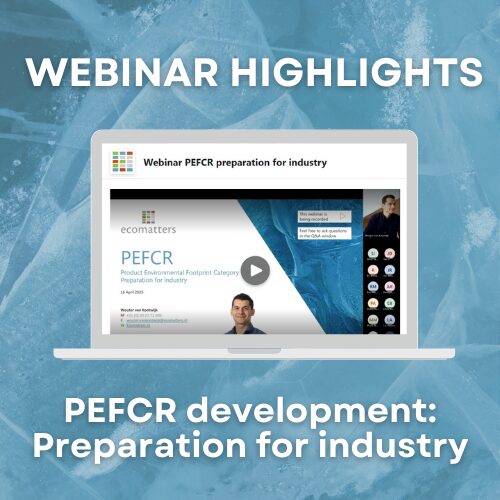
In this FAQ, we will discuss what a PEFCR contains, how to develop one, and the benefits a PEFCR can bring to industry members.
A Product Environmental Footprint Category Rule (PEFCR) is a sector-specific “rulebook” that explains exactly how to calculate the environmental footprint of products within a defined product group. It is based on the EU Product Environmental Footprint (PEF) method and translates that general method into practical, comparable rules for your sector.
A PEFCR provides key methodological choices to be employed when conducting a PEF study. This ensures every company in the sector conducts their study in the same way. Typically, it defines:
- A benchmark/representative product used for industry-level comparison
- The functional unit (what you compare products on)
- System boundaries and life-cycle stages to include
- Primary data and parameters to collect
- Approved datasets and modelling requirements
- Standard use-phase scenarios
- End-of-life and waste modelling rules
- Required impact assessment models
For members, a PEFCR provides:
- Fair comparability: everyone measures with the same assumptions making comparisons credible across the market.
- Lower study cost and time: predefined rules reduce time spent on each study.
- Clear study pathway: members know what to prepare for in data systems, supplier engagement, and/or product design.
- Direction for innovation and investment: impact hotspots become visible and consistent, providing clear guidance for R&D and helping direct investment toward impact reduction.
PEFCRs are developed by industry itself or commissioned by the European Commission.
When the commission is driving the development, a Technical Secretariat is set-up. This consists of companies that represent more than 50% of the EU market share and other stakeholders. Doing this ensures the decided rules reflect current technological realities and practical conditions. LCA experts support the overall process by helping to develop the rules and benchmark study, and by supporting the review process.
In the case where an industry organisation develops a PEFCR on its own initiative, there is more flexibility in terms of participation and market coverage.
The formal process followed by the European Commission has a number of steps, such as:
- Forming a Technical Secretariat and stakeholder group
- Agreeing the product scope and functional unit
- Producing initial draft rules and supporting studies across representative products
- Developing background datasets
- Validation and consultation
- Revision of the rules using gathered feedback, supporting studies outcomes, and new datasets
- Further validation and consultation
- Finalisation of rules, adoption, and rollout
If you want to make a formal PEFCR these steps are required. If your association is interested in understanding the consequences of certain modelling decisions or scenarios, it can be useful to go through a simplified version for internal understanding or to use as input for ongoing policy discussion with the European Commission.
PEFCR development typically takes a year, but for complex sectors this can be longer. Sufficient time is needed to ensure the rules are representative and to give your members the time to build data-collection processes and support the rule development. It also allows members to launch improvement programs before PEF studies or demonstrated impact reductions become formalised in the market or in policy.
A PEFCR lets your sector shape how it calculates its products environmental impact. PEFCRs are increasingly tied to EU policy tools under the Green Deal and related regulations, often becoming the reference for claims, reporting, and potential future labelling schemes. If your sector doesn’t define the rules, someone else will, and the outcome may not reflect your members’ reality.
Engaging ensures that any PEFCR developed by the European Commission reflects the technologies and real-world operating conditions relevant to your sector. This increases the chance that the resulting rules and benchmarks are practical, balanced, and aligned with the realities your members face.
When a process is initiated by the Commission, stepping in from the start (for instance by joining the Technical Secretariat) gives you a seat at the table before any key choices are made. Early involvement allows you to shape the direction, contribute data and expertise, and address questions before they become fixed in later drafts. In short, timely participation is the most effective way to support robust rules that work well for the sector and its members.
Associations that initiate PEFCR development typically coordinate member participation through different steps of the project:
- Support setting up the working group(s)
- which technologies and product variants must be covered
- coordinate which companies can provide data
- which data gaps may need sector-wide solutions
Members typically contribute through data provision and participation in working sessions or technical secretariat. The workload can be scaled depending on ambition: some organisations focus on a core group of committed companies first, then broaden involvement during consultations.
Ecomatters works alongside associations and member companies to make PEFCR development practical and credible. Support can include:
- Development of rules and process coordination (including setting up and supporting Technical Secretariat work)
- Coordinating and conducting supporting PEF studies
- Building background (EF compliant) datasets and tools
- Providing an independent review of draft rules and studies
- Preparing members for implementation after adoption
Ecomatters has a long track record in EU PEF and PEFCR projects and participates directly in the wider EU PEF community, so we can help you navigate both the technical and policy landscape. Get in touch with one of our PEF specialists to discuss PEFCR development.
Our experts



PEFCR services
PEF case studies and news
Learn more about our work supporting the development of PEFCR.

Case studies



Interested in learning more?
Get in touch!