
New technology only becomes valuable if it can perform in practice but also deliver a clear environmental benefit. That is what makes the Sunrey project so relevant. It shows why it is important to consider environmental performance at an early stage, while a technology is still being developed. The Sunrey project fits within the targets of the European Chemicals Strategy for Sustainability, to meet the large demand of the (petro)chemical sector for carbon-based chemical building blocks.
What is the Sunrey project?
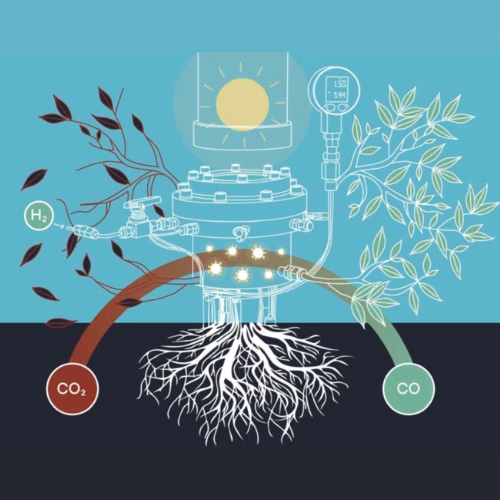
The Sunrey project is an innovation project aimed at developing and scaling a technology that uses sunlight as a catalyst for the conversion of CO2 and H2 into syngas. The ambition is to move from initial laboratory testing towards a pilot-scale installation.
Considering different lighting conditions for supplying energy to the reactor is central to the development approach. Sunlight serves as the primary light source and is captured through a solar concentrator. During periods of limited sunlight, LED lighting is used to complement the solar concentrator, helping to improve the overall output of the system while maximising the use of hardware and land area. This makes the technology development more realistic, because it reflects the practical conditions in which such a system would need to operate.
The project is carried out by a consortium of partners with complementary roles. TNO is leading the design and development of the pilot reactor and surrounding processes. Signify contributes LED lighting designed to match the reactor requirements. The pilot reactor is installed at the Brightlands Chemelot Campus, where innovative technologies can be developed and integrated in a relevant industrial setting. The University of Amsterdam research opportunities for direct use of syngas to produce fine chemicals. Our role at Ecomatters is to carry out the life cycle assessment (LCA) to understand the environmental impact of the technology under development.
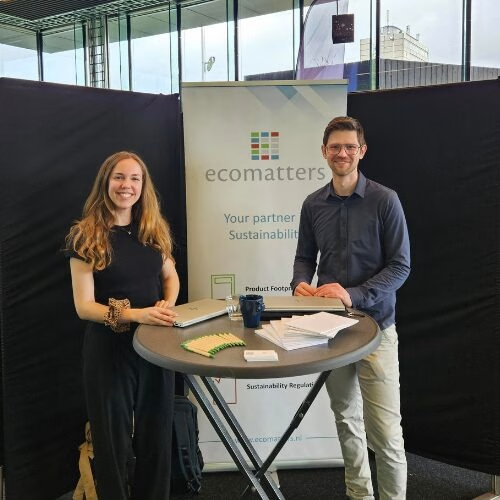
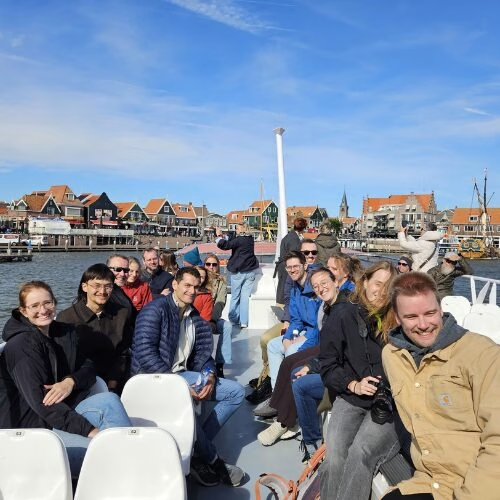
At the end of January, an outreach event was organised at the Brightlands Campus to share the current status of the project, its activities and the relevance of the technology within today’s industrial and economic context.
Why Life Cycle Assessment is important in the Sunrey project
When a new technology is still under development, there is often a strong focus on technical feasibility, efficiency, and scale-up. Those aspects are, of course, important, but they do not automatically show whether the solution will also deliver environmental value across the full system.
That is where Life Cycle Assessment plays an important role. Within the Sunrey project, Ecomatters is responsible for carrying out this assessment. In the first iteration, the assessment uses preliminary data and assumptions regarding expected utility demand, material use and conversion efficiency. Even at this stage, the results will already indicate which processes contribute most to the overall environmental impact across the system.
This is particularly useful in innovation projects. Rather than waiting for perfect data, an early LCA supports smarter decisions during development. It gives researchers and engineers a clearer basis for refining design parameters and prioritising the areas with the highest potential for improvement.
The Sunrey project is now in its second year of its four-year programme, making it a good moment to assess where the main environmental opportunities and risks lie. A second LCA iteration is planned for a later stage, once pilot data becomes available. That will allow the assessment to be refined and the quality of the results improved.
The broader lesson is clear: if we want clean technologies to succeed, we need to consider technical and environmental performance together. The Sunrey project is a good example of how that can work in practice.
If you would like to discuss working with Ecomatters on LCA for research projects or emerging technologies, contact us or schedule a call with one of our experts.
This article was written by Freya Goffart De Roeck, a sustainability consultant at Ecomatters. This project receives funding from Topsector Energie (TSE) Industrie studies through the MOOI subsidy scheme.